


Farmer Shop Heating
Your Shop Loses Heat Every Time That Door Opens
Forced-air and hanging heaters warm the air — and the air is gone the second you open a 14-foot door to pull in the tractor. You end up running the heater constantly just to fight the draft, and the floor stays cold the whole time.
Concrete works differently. It's thermal mass — once it's warm, it stays warm, and it keeps radiating that heat back into the room even after a door opens and closes. Your feet, your tools, and anything sitting on that floor stay warm, and the room recovers fast once the door shuts.
That's the whole idea behind in-floor heat in a farm shop: heat the thing that holds the heat, not the air that leaks out.
Why Concrete + HUG
You're not doing this every year. When you pour a shop floor, it needs to be right — because you're not repouring it in five years. HUG Hydronics is designed the same way:
-

12-year limited warranty
with parts serviceable by swapping — no specialized tools, no calling someone out to a farm 40 minutes from town.
-

900–5,000 sq ft coverage, up to 8 zones
— sized for anything from a single-bay shop to a full machine shed with an attached heated area.
-

Works with the heat source you already have or plan to add
— electric, gas, LP, wood, or solar boiler (heat exchanger may be required).
-

Code-approved
for installation by homeowners, not just licensed plumbers — this is built to be a DIY job.


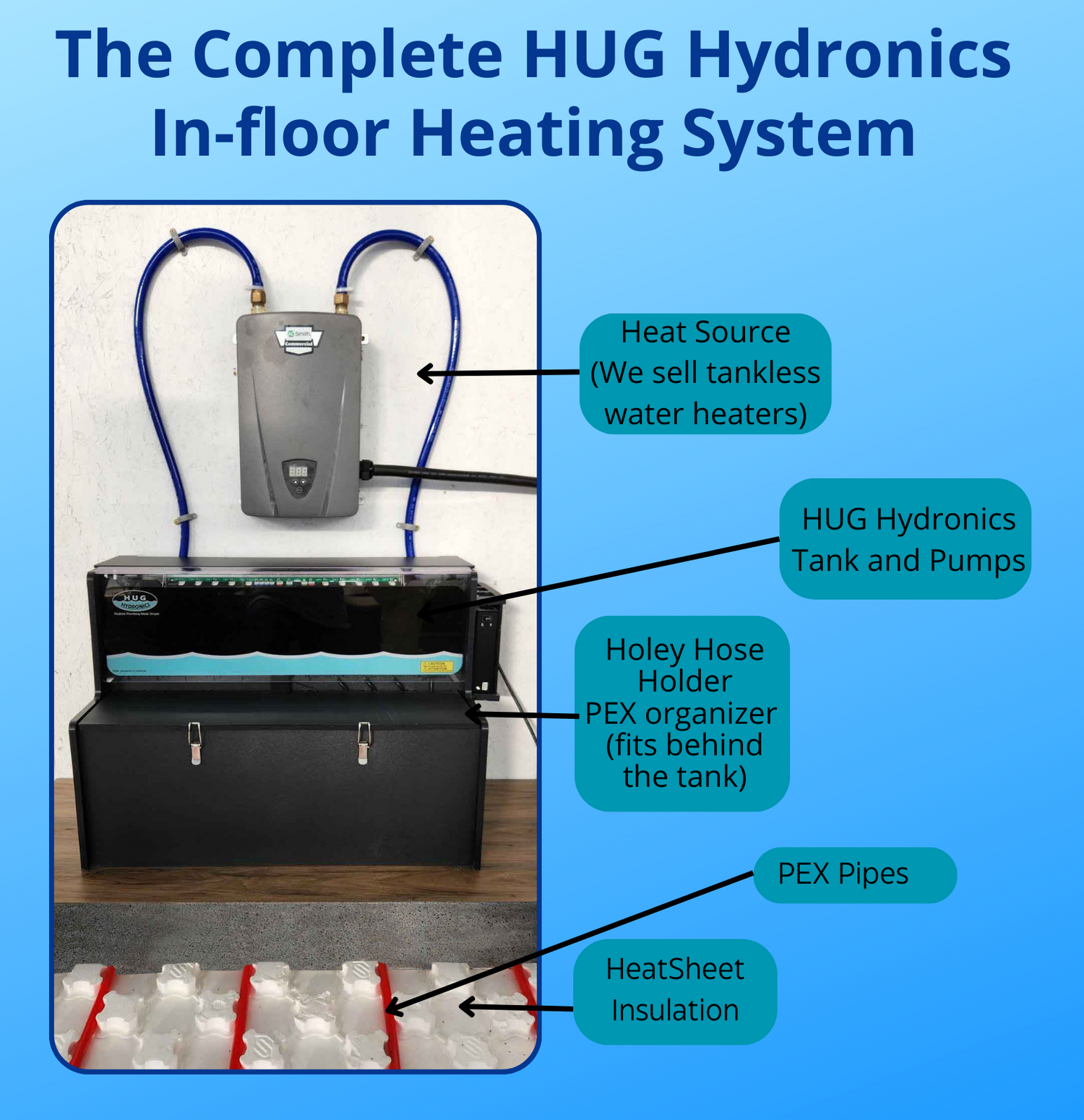
What's a HUG Hydronics In-floor heating system?
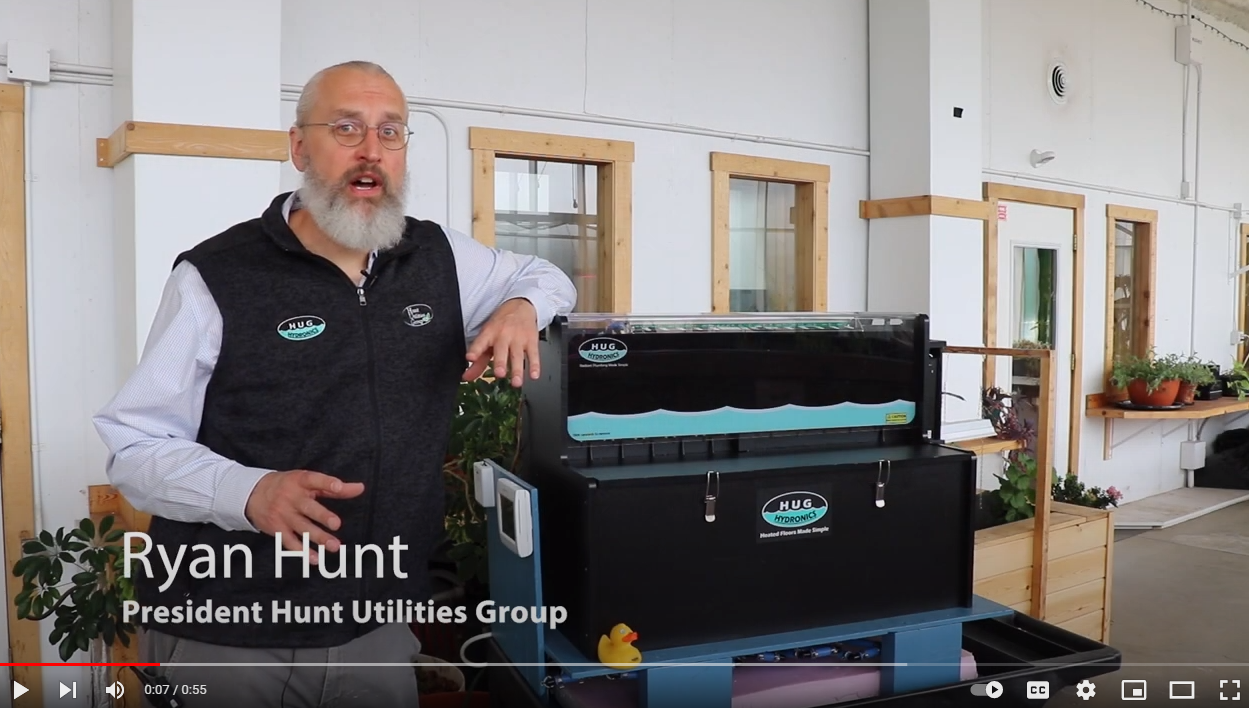
How it works:
-
Plan before your pour-
Try our free sizing toolA good in-floor heat job has two parts: what goes under the concrete (insulation and PEX tubing, done before the pour) and the mechanicals (pump, manifold, controls — connected after). Skipping insulation under the slab is the #1 way to waste heat into the ground instead of your shop. HUG offers the best ways to do both.
-
Now
- Size it before you pour. Use the free sizing tool with your building dimensions and door count to get a system recommendation — insulation, PEX layout, and zone count. This has to happen at the planning stage, not after the concrete's down.
- Order in the stages that fit your project. Get the underfloor package (insulation + PEX) now to install before your pour, and add the mechanical package (pump, manifold, controls) whenever you're ready to bring the system online — or order everything together as one kit if your timeline's tight. Either way works.
-
While building
- Lay the underfloor package before the pour. This is the insulation and PEX tubing work, done on schedule with your concrete crew — timing depends on your building size and layout, not a fixed number.
- Connect the mechanicals — about an hour. Once the concrete's cured and you're ready to bring the heat online, hooking up the pump, manifold, and controls is the fast part: roughly an hour, no plumber required.
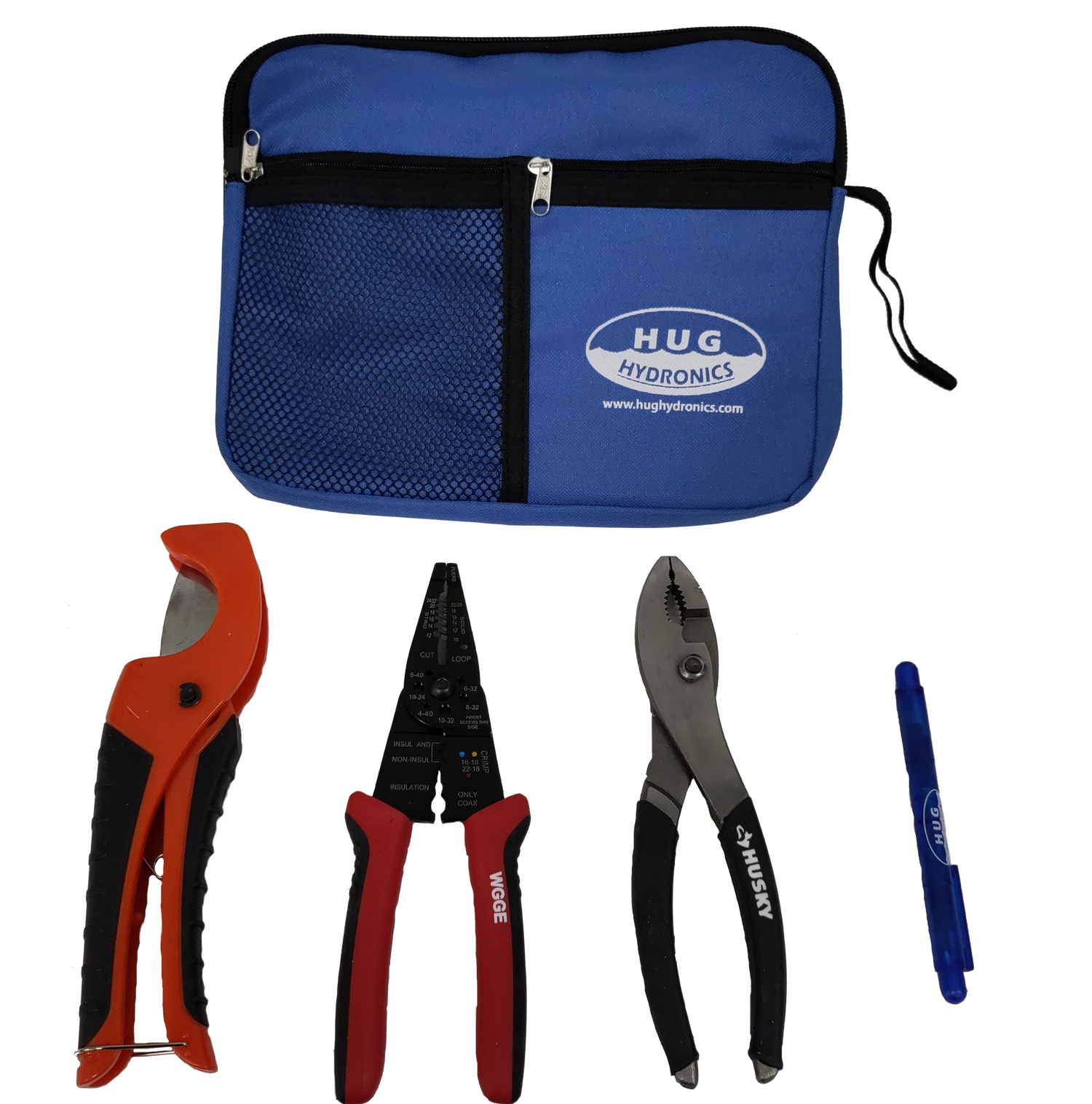
Only 4 tools needed
- A small screwdriver — thermostat wires
- A wire stripper — thermostat wires
- A pipe cutter — PEX pipe to length
- A pair of pliers — tighten clamps
Mostly, you connect it, fill it with water, and turn it on.

Jim Chamberlin — Island Lake Farm
"I bought the 3rd one off the shelf... worked so well we bought another one when we built a tiny house for our son."
Specs Table
| System | HUG Hydronics (Standard) | HUGmini |
| Coverage | 900 – 5,000 sq ft | 300 – 1,000 sq ft |
| Zones | Up to 8 | 1 |
| Compatible heat sources | Electric, gas, LP, wood, solar (heat exchanger may be required) | Electric only |
| Power connection | Standard wiring to your heat source | Plugs into the wall — requires a dedicated/special outlet |
| Underfloor install (insulation + PEX) | Done before the pour; time varies by building size | Done before the pour; time varies by building size |
| Mechanical install | About 1 hour | About 1 hour |
| Order format | Underfloor and mechanical packages separately, or as one complete kit | Underfloor and mechanical packages separately, or as one complete kit |
| Warranty | 12-year limited (3-year full) | 12-year limited (3-year full) |
| Code approval | Approved for U.S. and Canada, installable by homeowners | Approved for U.S. and Canada, installable by homeowners |
FAQ
Will in-floor heat really keep up with a shop that has a 14-foot door?
Yes — because concrete stores heat rather than losing it the moment air escapes. The floor keeps radiating warmth even right after the door opens, and recovers quickly once it's shut. This is why concrete outperforms forced-air heat in buildings with large doors.
Can I install this myself, or do I need a plumber?
Yes — HUG Hydronics is code-approved for homeowner installation. The job happens in two stages: laying the insulation and PEX tubing before you pour (timing depends on your building size), and connecting the PEX pipes to the tank, and the tank to the heat source. (Takes about 1 hour).
What size shop or pole barn does this work for?
The system covers 900 to 5,000 square feet across up to 8 zones, so it scales from a single-bay shop to a full machine shed. The HUGmini is perfect for up to 1,00 sq ft, but is only offered in electric.
What if I already have a boiler or water heater?
HUG works with electric, gas, LP, wood, or solar heat sources — a heat exchanger may be required depending on your setup.
What happens if something breaks years from now?
The system carries a 12-year limited warranty (3 years full), and parts can be replaced without specialized tools — no need to tear out concrete to fix a failure.
Do I need to install this before I pour the slab, or can I retrofit?
It's most straightforward installed before the pour, but retrofitting into an existing slab or building a new heated section is possible — use the sizing tool or call us to talk through your specific building.
Does the HUG tank system need special wiring?
No — the HUG tank itself plugs into a normal outlet. Your heat source (boiler, water heater, etc.) may have its own electrical or gas requirements depending on which one you choose — check that heat source's spec sheet, or use the sizing tool to get a recommendation that fits what you already have.
Does the HUGmini need special wiring?
Yes — the HUGmini runs on 240V power, similar to what a dryer uses. The outlet itself is included in your package, so all you need is to have your space wired for a 240V outlet wherever you want the HUGmini installed. If you don't already have 240V run to that spot, you'll need an electrician to add it before setup.
Building a Shop You'll Only Build Once?
Get a cost estimate before you pour.